The Weight of the Saw
December 3, 2025 • David Macintosh
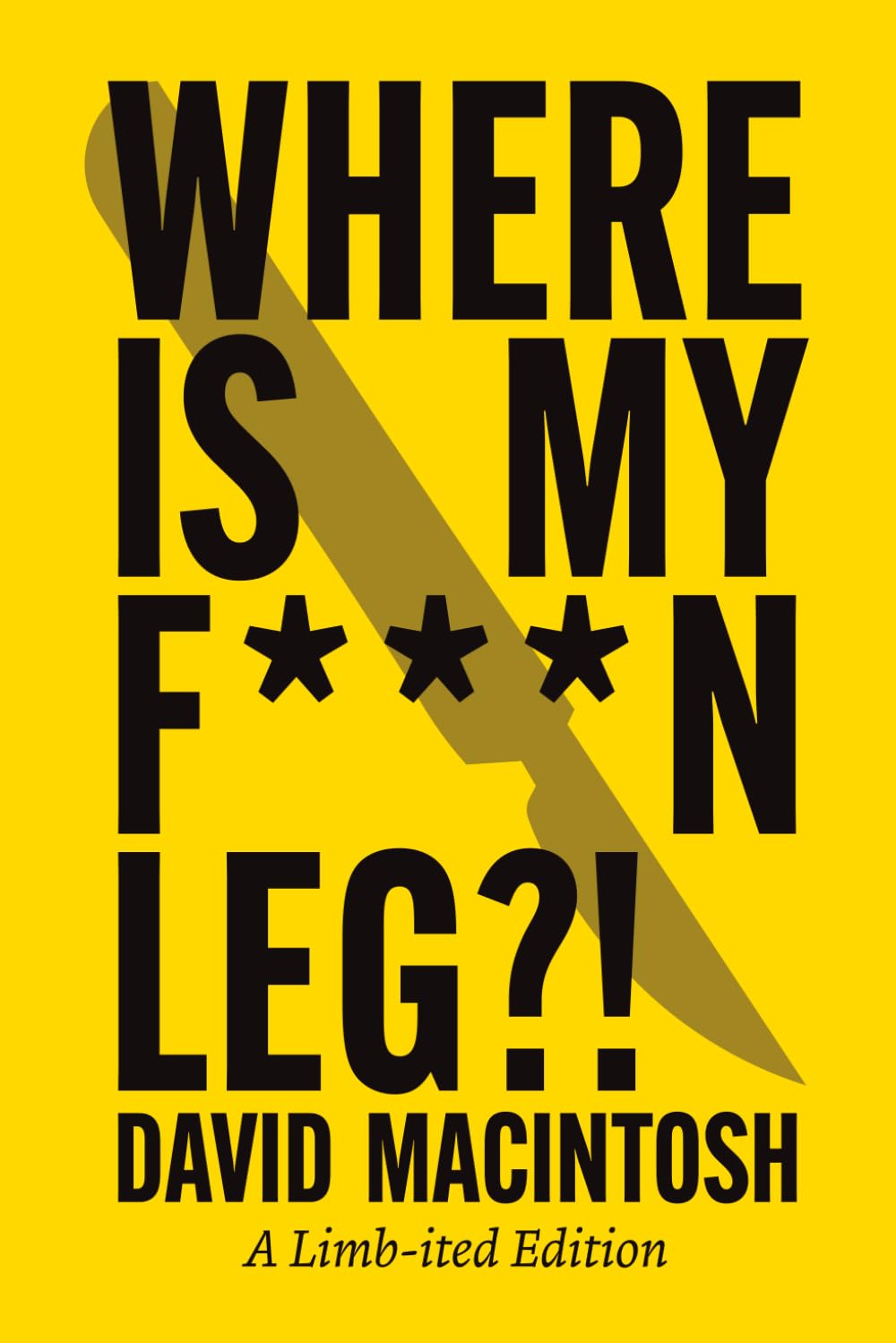
Reflections on Where Is My F**N Leg?.
Chapter 1
Kim
The leg was heavy in my hands. Heavier than anatomy would suggest, heavier than bone and muscle and skin should weigh. I steadied it while my registrar made the final cuts, and I thought: this is how it ends. Not with healing, but with separation. Not with repair, but with removal. The power saw whined, the bone gave way, and a young man's leg became something else entirely. Something to be disposed of. Something that would never again carry him across a building site or kick a football with his future child.
I have held many legs. I have pinned them, plated them, nailed them back together. I have spent hours painstakingly reconstructing what violence has torn apart. But some things cannot be reconstructed. Some damage is beyond repair. The skill of surgery lies not only in knowing how to fix, but in knowing when fixing is no longer possible. When the attempt to save will kill.
It was a Friday night in the wet season, rain torrential, the road to the hospital a river. A young builder had come off his motorbike and been crushed under a bus. By the time I saw him, his leg was a ruin: bone shattered, muscle crushed, arteries thrombosed, nerves contused beyond function. No pulse in his foot. No sensation in his toes. And his abdomen full of blood from a ruptured liver that had to be dealt with first, while his leg waited, ischaemic, dying by degrees.
Five hours passed before we could address the leg. Five hours during which the damage deepened, the tissues died, the window for salvage narrowed alarmingly. The contamination was deep, the crushing extensive, the blood supply gone. We cleaned and debrided, removed what was obviously dead, but the anaesthetist was already at my ear: oxygen falling, blood pressure dropping, heart showing strain. The toxic products of dying muscle were poisoning him.
My registrar wanted to try. Put on an external fixator, give it a chance, see if the circulation might recover. He was thinking of the leg. I was thinking of the man. A leg that might be saved is worthless if the patient dies in the saving. The calculus is brutal but unavoidable: sometimes you sacrifice a part to preserve the whole.
I made the call. Above the knee, through clearly viable tissue, no room for doubt or compromise. My registrar cut while I retracted. The saw did its work. The leg came away. And within minutes, the numbers improved. Oxygen up, blood pressure stabilising, the heart settling into a rhythm it could sustain. The anaesthetist exhaled audibly. Good decision, he said. I nodded, but I was not so sure.
That's the thing about these decisions. You never know. You make the best judgment you can with the information you have, under the pressure you're under, and then you live with it. There is no control group, no parallel universe where you chose differently and can compare outcomes. The leg is gone. The man survived. Was it necessary? Would he have survived anyway, with his leg intact? Would a below-knee amputation have healed, giving him a better prosthetic outcome? I will never know. No one will ever know.
I drove home through air thick with humidity, the rain stopped, the smell of the sea drifting up from the esplanade. My house was quiet, my bed empty. I lay awake replaying the evening, every decision, every observation, every moment when I might have chosen differently. The weight of the saw still in my hands. The weight of a choice that could not be unmade.
People imagine that surgeons are certain. That we stride into theatres knowing exactly what to do, execute our plans with precision, and stride out again confident in our success. Some surgeons cultivate this image. I have never been one of them. Every major decision carries doubt. Every operation involves judgment calls that could go either way. The difference between a good surgeon and a dangerous one is not the absence of uncertainty but the willingness to act despite it, to make the best decision possible and then commit to it fully, even while knowing you might be wrong.
But commitment in the moment does not prevent doubt in the aftermath. That night, alone in my bed, I questioned everything. Should I have pushed for earlier theatre access? Should I have attempted a below-knee amputation despite my concerns about tissue viability? Should I have tried the external fixator, bought more time, waited to see if his circulation improved? Each alternative unfurled in my imagination, each with its own cascade of possible outcomes, most of them worse than what I had chosen but some, perhaps, better.
I thought about his wife, pregnant with their first child, waiting in a corridor while strangers decided her husband's fate. I had not spoken to her. My registrar had delivered the news, explained the possibilities, obtained her consent. I had been on the phone to my own child, my daughter upset about some playground incident, my mother late because of flooding, dinner chaotic, everything pulling in different directions at once. The wife had wanted to meet me. She had not.
This is what they don't teach you in medical school. Not the anatomy of amputation, which is straightforward enough, but the anatomy of aftermath. How to carry the weight of decisions that reshape other people's lives. How to function when you're simultaneously responsible for a dying patient, a distressed child, an anxious relative you haven't met, and a registrar who needs teaching even as the crisis unfolds. How to lie awake at 3 a.m. knowing that in a few hours you'll face a room full of colleagues ready to question your judgment.
Monday morning would come, as it always does. The weekly meeting where every case is reviewed, every decision examined, every outcome held up to the light. Some colleagues would nod; others would wonder if I had been too hasty. One would ask why I hadn't tried below the knee. Another would suggest the external fixator might have bought time. They would not have been there, would not have seen the grey pallor of ischaemia spreading up his leg, would not have heard the anaesthetist’s warning or felt the urgency of a patient slipping away. But they would have opinions, nonetheless.
I think I made a good decision. Most days, I believe that. The man lived. His wound healed. He walks now on a prosthesis, works in a modified capacity, has a child he would never have known if I had hesitated too long. But believing is not the same as knowing. And in surgery, we rarely get to know. We get outcomes: some good, some bad, most ambiguous. We tell ourselves stories about why things happened as they did. We construct narratives of causation and consequence. But the truth is more uncertain than any of us like to admit.
The leg was heavy in my hands. I remember that weight more clearly than anything else from that night. Not the technical details of the amputation, which were routine enough. Not the relief when his vital signs stabilised, though I felt it. Not even the long drive home through the humid darkness. What stays with me is the weight: physical, moral, permanent. The weight of holding someone's future in your hands and knowing that whatever you decide, you will carry it with you forever.
Young surgeons sometimes ask me how to handle this. I tell them the truth: you don't handle it, not really. You learn to live with it. You develop ways of processing the doubt, compartmentalising the uncertainty, moving on to the next patient while the last one still haunts you. You talk to colleagues, sometimes. You lie awake, often. You accept that this is the price of the privilege, the cost of being trusted with decisions that cannot be unmade.
And on the nights when sleep won't come, when the weight presses down and the doubts circle endlessly, you remind yourself why you do this. Not for the certainty, because there is none. Not for the gratitude, which is fleeting when it comes at all. But for the moments when your judgment, however imperfect, however haunted by doubt, makes the difference between a young builder going home to meet his child and a young widow burying her husband. You do it for those moments. And you carry the weight because someone has to, and you have the hands for it, even when those hands tremble in the small hours of the morning.
Other Posts